
Breckenridge vs Dallas. The Hidden Cost Advantage
A small oil town with almost $2M in reserves and lower living costs than Dallas. Breckenridge has serious cash and planning discipline, but a tax base tied to oil and construction.
EDO Power Law #3: Numbers First, Always.
If you cannot explain the budget, tax base, debt, and capacity simply, you are not ready to sell.
Upgrade to Texas Street All Access | $50/month and, in addition to this weekly brief, access…
Texas Street Trends, a premium monthly deep-dive covering the biggest economic, infrastructure, and industry shifts in Texas. If you’re trying to see early signals, spot risks before they hit Council, or stay ahead of competing cities, this is for you.
Subscriber-only playbooks, templates, and charts you can plug straight into your next pitch, briefing, or strategy session.
Texas Street Connect, a private community for Texas EDO leaders and local decision makers. A place to share what’s working, compare notes, ask questions, and get clarity fast. [Launching January 1st, 2026]
You’re no longer doing this alone.
All-Access gives you statewide intelligence and a network of operators who are in the trenches with you.
$50/month. Cancel anytime.
The first 30 founding members will help shape the community from day one.
Last week’s EDO Roundup…
Watersong pitches $27M “Nature Commons” to Midland DC – Dec 1, 2025
Midland’s I-20 Wildlife Preserve (now Watersong Wild Space) is trying to level up into a full “Nature Commons” campus with a 25k sq ft education and research hub. They’ve already raised seven figures quietly and are asking the Midland Development Corp. to help close a $27M plan over a few years. Less about job count, more about making Midland a place families and talent actually want to stick around in.Bastrop County scores $43M to finally wire up its gaps – Dec 2, 2025
Bastrop just landed a massive BOOT II broadband grant to get fiber to more than 10,000 unserved homes and businesses, with the private provider chipping in another $11M. Construction is already moving, with work supposed to wrap next year. This basically redraws the map for where remote workers and small firms can realistically set up shop.McKinney EDC plugs into VC Arena to pull more startups north – Dec 2, 2025
McKinney is turning its Innovation Fund into more than just a grant pot by partnering with VC Arena’s founder–investor network. Idea is simple: if you are a high-growth startup, McKinney wants to be in your deal flow, not hearing about you after you pick Austin or Dallas. It is a quiet but smart way to turn incentives into an actual startup pipeline.Nexus plans a 612 MW gas-fired data center campus in Hubbard – Dec 3, 2025
A data center developer is dropping a 612 MW campus in tiny Hubbard and bringing its own natural-gas generation with it. That means less waiting around in the ERCOT line and more control over power, which is basically the new site-selection currency. Job numbers won’t be huge, but the tax base and construction impact are enormous for a town this size.Perseus Defense picks Buda for HQ and missile manufacturing – Dec 4, 2025
A Y Combinator defense startup building guided micro-missiles is planting its HQ and manufacturing in Buda’s Tower Business Park. They start with 20 jobs but project up to 400 high-pay roles within five years, with average wages well into six figures. Buda and the EDC backed it with a performance-based package that stays pretty tight and focused on actual job creation.Warrior Technologies expands into Pecos and raises local equity – Dec 6, 2025
Midland-based Warrior Technologies is opening a new hub in Pecos to keep up with Delaware Basin demand and is asking local investors to help fuel the next round of growth. They are hiring across field techs, CDL drivers, and operators off the back of a big three-year contract. It is one of those blue-collar service plays that quietly carries a lot of regional employment.Ninth Avenue Foods’ $200M Longview plant keeps getting national love – Dec 6, 2025
Longview’s big win with Ninth Avenue Foods is back in the national trade press: $200M+ in investment and roughly 150 jobs over five years at a new beverage manufacturing plant. This is the third plant for the California-based company and deepens Longview’s food-and-bev cluster. Every new mention just reinforces “Longview” as a safe, proven choice for similar projects.Rosenberg greenlights a $236M hotel and convention center at Fort Bend Epicenter – Dec 7, 2025
Fort Bend is finally adding the missing piece next to its big Epicenter arena: a full-service hotel plus 70k sq ft of convention space. Most of the $236M cost is covered through county-backed debt and long-term hotel tax recapture, with the city rebating its hotel tax from the project for 30 years. It is a classic “build the beds so the big events will actually stay” move.
Breckenridge’s Real Edge. Cheap Living, Cash on Hand
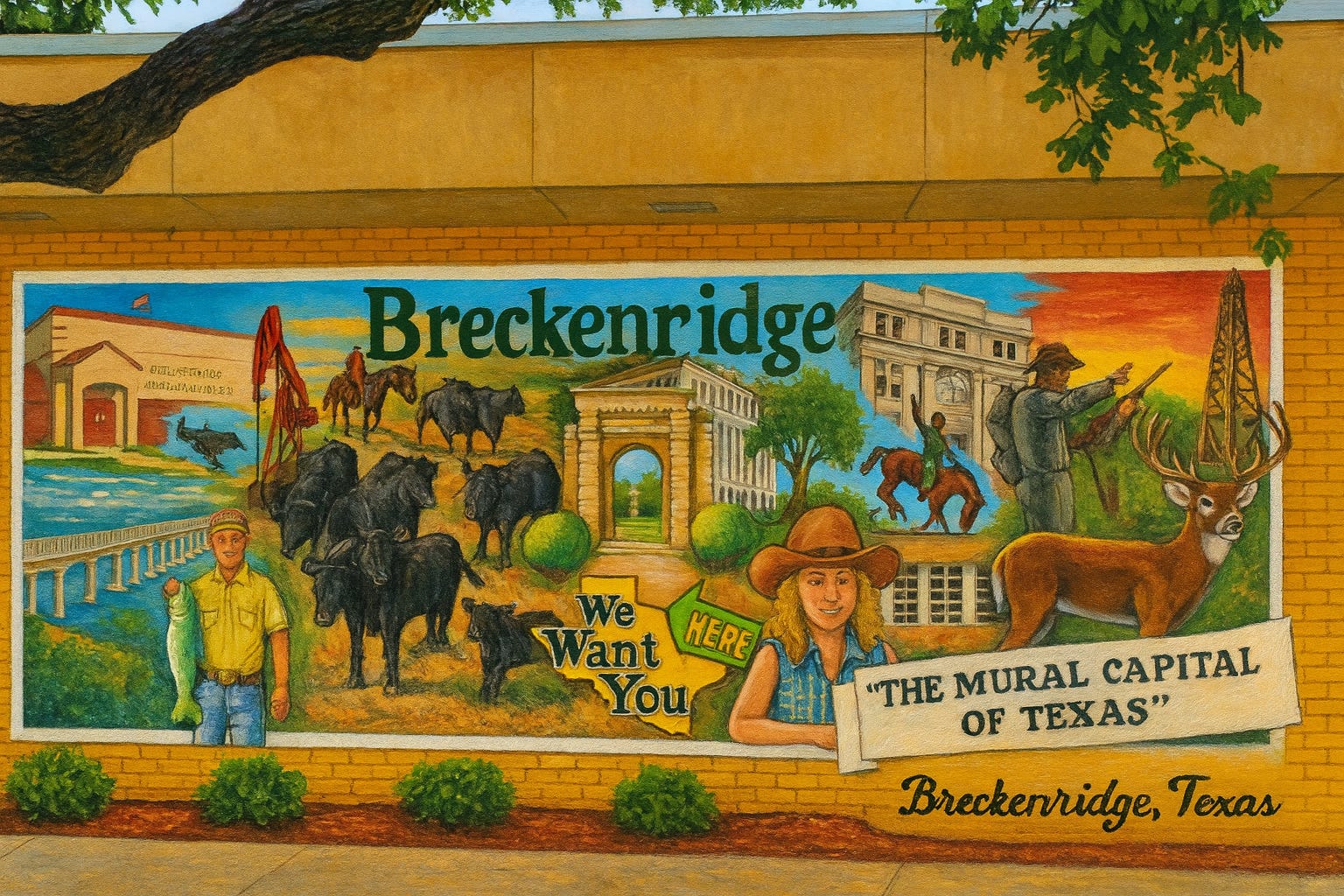
Issue 21
B.L.U.F. Breckenridge is a fiscally disciplined, cash-rich small city sitting on a very volatile industrial base. The city holds nearly $1.94 million in unencumbered General Fund reserves and publishes clear, statutory tax-rate disclosures, which gives it real capacity to move quickly on incentives and infrastructure without new debt.
The catch is concentration.
The local and county economies lean hard on construction, manufacturing, and oil and gas extraction, with many of the best-paying jobs tied directly to energy cycles. At the same time, living costs run well below the national average and notably below Dallas, which gives Breckenridge a strong cost-of-living story for recruiting both firms and workers away from higher-cost metros.
City Financial Profile
Breckenridge’s finances are conservative, transparent, and more mature than many cities its size. The city has real cash reserves and clear tax disclosures, but part of its rate is locked up by mandated hospital costs, which tightens room for discretionary moves.
As of the 2025 tax notice, Breckenridge estimates an unencumbered General Fund (Maintenance and Operations) balance of $1,938,658, plus $204,855 in the General Debt Service Fund. These balances are not pledged to specific debt and function as true reserves.
Current-year property tax–backed debt service is driven by the CO Series 2023 issue, with a total 2025 payment of $633,450. All of it is scheduled to be paid from taxes, with no draw on the unencumbered funds or other resources.
After accounting for last year’s excess collections, the city expects to pay $597,390 from 2025 property taxes toward this debt, then adds $59,082 to reflect a 91 percent collection rate, for a total 2025 debt levy of $656,472.
The 2025 no-new-revenue tax rate is $1.00219 per $100 of value, the voter-approval rate is $1.05906, and the de minimis rate is $1.19090, which defines the city’s legal tax headroom.
Hospital obligations operate as a built-in drag on tax capacity. From July 1, 2024 to June 30, 2025, the city spent $118,400 on eligible county hospital operations, up from $102,067 the prior year. The extra $16,333 raised the voter-approval tax rate by $0.00323 per $100 to legally recoup 8 percent above last year’s spending.
Breckenridge levies the standard 2.0 percent local sales and use tax rate, which helps diversify revenues away from the property tax.
Takeaway: For its size, Breckenridge behaves like a well-run mid-sized city. It has almost $2 million in free General Fund cash, a clearly defined debt service profile, and a strategic budget process.
Economic Drivers
Breckenridge is a classic industrial town. Its core strength is a skilled trades workforce in construction and manufacturing, but the county economy stacks that base directly on top of oil and gas extraction.
In 2023, Breckenridge had about 2,230 employed residents, with employment growing 1.78 percent from 2,190 in 2022.
The three largest city-level industries by employment are Construction (337 people), Manufacturing (333), and Educational Services (258). That mix reflects a hands-on industrial base supported by a steady public education anchor.
The county economy amplifies this industrial pattern. In Stephens County, the largest sectors are Construction (524 people), Manufacturing (517), and Mining, Quarrying, and Oil & Gas Extraction (463), with oil and gas also among the highest-paying industries.
At the job level, the most common occupations inside the city are Construction and Extraction roles (304 people) and Production jobs (303 people), followed by office and administrative support. This confirms a strong blue-collar skills base ready for plant, shop, and field work.
Oil and gas and related industries pay some of the highest wages in the local area, with mining-related industries in Breckenridge and Stephens County reporting average earnings in the mid-$70,000s. That income concentration makes the local tax base more sensitive to drilling and capital-spending cycles than a service-heavy town.
Takeaway: Breckenridge has real industrial “muscle” for a small town. It can credibly support fabrication, maintenance, and construction-heavy operations on day one. The risk is that a large share of that capacity already rides the same energy cycle. When oilfield capital spending falls, construction, manufacturing, and extraction jobs all feel it at once, which makes diversification less optional and more of a fiscal safety plan.
Business Climate and Growth Indicators
Breckenridge pairs its industrial base with a surprisingly formal planning and infrastructure mindset. The city is not a “anything goes” growth market. It is methodical about land use, zoning, and utility capacity.
Community Development manages planning, zoning, permits, and development review. The department’s stated focus is on compatible land uses, quality building materials, and protecting public health and property values, which is important for industrial neighbors and residential infill alike.
The city has been updating zoning and its Future Land Use Map (FLUM), including public open houses to gather feedback on how to direct retail and industrial development along key highway corridors.
For larger or phased projects, Breckenridge uses a stepped process of zoning, preliminary plat, final plat with detailed infrastructure plans, and site plan review. For complex multi-phase work, a master plan is required so roads, easements, and utilities are planned up front, not patched in project by project.
The city used Texas Community Development Program (TxCDBG/TCDP) dollars to fund a comprehensive study of its water and wastewater systems. That analysis inventoried existing infrastructure, mapped the system, and projected future needs, including a 2030 population of 6,130 and peak-day water demand of 2.81 million gallons per day (MGD).
These water and wastewater projections are built directly into the comprehensive plan and capital planning framework, which matters for any industrial user that cares about long-term capacity rather than one-time taps.
The Breckenridge Economic Development Corporation serves as the city’s main development arm, with a volunteer citizen board appointed by the City Commission. That structure ties incentive and recruitment decisions to local priorities and political support.
Takeaway: Breckenridge is not winging it. For a small town, it has a serious planning culture, a water and wastewater plan backed by real numbers, and a defined review process for land development. For site selectors, that reduces surprise. For competitors, it means Breckenridge can credibly claim “we have a plan and we know our capacity,” even if some future capital projects are still waiting on final budget adoption.
Opportunity Gaps
Breckenridge’s gaps look less like weaknesses and more like open lanes for builders. For local founders and outside operators, the mix of low costs, trades talent, and small-town scale creates room for real companies, not just one-off projects.
Local Industrial Shops That Sell Beyond Oil and Gas
Market Opportunity: Build small and mid-sized fabrication, repair, and industrial service businesses that use Breckenridge’s construction and production talent but sell into non-energy markets across Texas and the U.S.
The Need / Gap it addresses: Too much of the current industrial base leans on oil and gas capital spending. When drilling slows, local work dries up. Breckenridge has the skills and training partners to support shops that serve food processing, logistics, ag equipment, and general industrial customers, but those firms are underrepresented today.
Workforce Housing and Quality-of-Life Upgrades for Trades Families
Market Opportunity: Develop and upgrade attainable rentals, starter homes, and neighborhood-scale amenities aimed at skilled trades workers and young families who want shorter commutes and lower monthly costs than Dallas–Fort Worth.
The Need / Gap it addresses: Breckenridge’s cost of living sits well below both the national average and major metros, yet much of the housing stock is older and there are limited “move-in ready” options for new arrivals. The city can attract Metroplex wage earners and local talent to stay, but it needs fresh housing product and everyday services that match what those families are used to.
Remote-Capable and Niche Service Firms Built on Cost Advantage
Market Opportunity: Launch remote-first or hybrid firms, such as back-office operations, creative studios, bookkeeping, technical support, or niche consulting, that base in Breckenridge for cost reasons but serve clients in Dallas, Houston, Austin, and beyond.
The Need / Gap it addresses: The local story is still tied to rigs and repair yards, not laptops and service work. There is no clear “work-from-here” narrative for professionals who could live cheaply, enjoy short commutes, and still earn metro-level incomes. Creating that niche opens a new layer of the tax base that is not tied to commodity cycles.
Takeaway: If Breckenridge leans into these three lanes, it can stack wins from the inside out: more resilient local shops, better housing for the people who already power the economy, and a small but growing layer of remote and service firms. That combination would slowly shift the city from a town that rides the oil cycle to a town that uses its cost advantage and trades talent to write its next chapter on its own terms.
Closing Insight
Breckenridge is the kind of town that forces you to think in layers. On the surface it reads like a small, industrial community tied to energy cycles. Underneath, you find a city that keeps cash in reserve, plans ahead, and quietly offers one of the strongest cost advantages in its weight class.
The real question is how you choose to position against places like this. Do you try to outbid a cost-advantaged trades town on its own terms, or do you build a different lane that turns Breckenridge into part of your labor shed and supply chain instead of a pure competitor?
Next Town: Fort Stockton, Texas
Have a great week! See you next Monday.
Grateful,
Omegadson
P.S. Don’t forget to connect with and follow Texas Street on LinkedIn and Facebook.
Whenever you’re ready, EDO leaders…
Strategy Session w/ me; focused 30-minute meeting designed to quickly align on goals and priorities. You can expect crisp insights, well-defined next steps, and an actionable plan to move your strategy forward in a concise, decision-driven format.
→ Book a free 30-minute strategy call